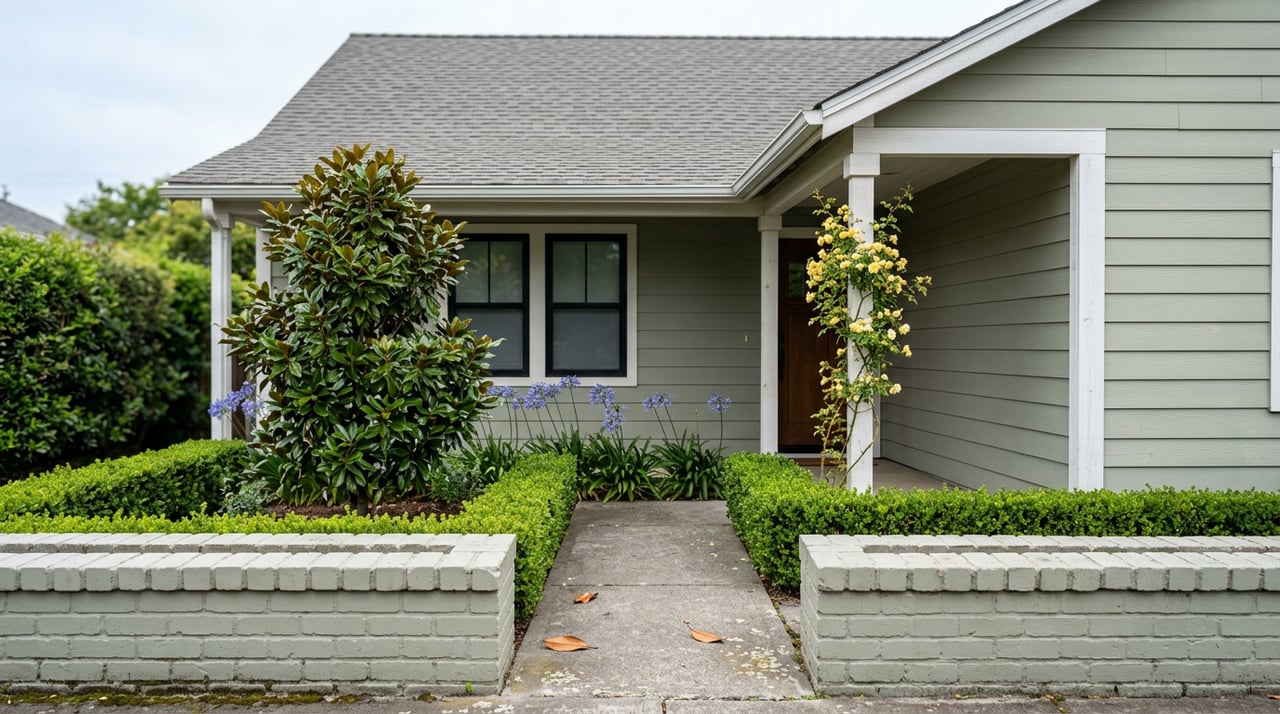
In Coronado, Being Old Doesn't Mean Being Historic Anymore. Here's Why That Split Matters at the Closing Table.
September 10, 2026
September 10, 2026
Is that 1938 cottage in the Village historic, or just old? Until recently in Coronado, the two questions had the same answer. If a house was 75 years or older, touching an original window or porch that faced the street meant a public hearing in front of the Historic Resource Commission, whether or not anyone had ever called the house architecturally significant. Age alone was the trigger.
That changed. Over 2023 and 2024, the city ran homes in the Village, plus separated homes built before 1970, through a formal survey, then sorted the results into three tiers. In November 2025, the City Council voted unanimously to let most of those properties skip the hearing altogether. For a buyer or seller working with a pre-war Coronado address, that vote is the single most useful fact in the file, and it is not the one most listing conversations lead with.
The Historic Resources Inventory covered 2,044 properties. Here is how the city's own tier matrix sorted them:
| Tier | Properties | What it means for renovation |
|---|---|---|
| Tier 1 | 201 | Strong architectural case for historic status; a Determination of Historic Significance Review is still required before altering original street-facing features |
| Tier 2 | 145 | Same review requirement as Tier 1 |
| Tier 3 | 1,698 | Exempt from that review requirement as a baseline, though an owner can still pursue formal designation voluntarily |
Run the math and 83 percent of the surveyed inventory landed in Tier 3. That is the finding worth sitting with. The assumption that an old Coronado house automatically means red tape and a Historic Resource Commission hearing before you can replace a porch rail was true for nearly every property in the city until late 2025. Now it is true for roughly one in six.
The exemption applies to the specific trigger written into Chapter 84.10 of the Coronado Municipal Code: demolition or removal of original features visible from the street right-of-way, on a structure 75 years or older. If your house is Tier 3, that review is off the table by default. If it is Tier 1 or Tier 2, the hearing requirement stands.
Before the November vote, Councilmember Amy Steward spent weeks walking Coronado block by block with a spreadsheet, checking the survey's Tier 3 calls against the actual houses. She got far enough into the exercise that a patrol officer, unaware of what she was doing, stopped to ask why she was casing houses. Mayor John Duncan turned the story into a running joke at the October 21 meeting, telling her, "And please check on the suspicious woman parked outside my house."
The joke aside, Steward's fieldwork mattered. By the time she reported back, she had flagged about 40 Tier 3 properties she thought deserved a second look before losing the review requirement, and she committed to bringing that list to a future meeting. That detail tells you something the tier matrix alone doesn't: the classification a property carries today is not necessarily where it will sit permanently. The city has kept individually reclassifying addresses since. A council agenda earlier this year, for instance, took up reclassifying eight specific properties into Tier 2, including houses on B Avenue, D Avenue, and F Avenue. If you are buying an older Coronado house, the tier assigned in 2023 is a starting point, not a guarantee, and it is worth confirming on the city's current interactive preservation map rather than assuming it hasn't moved.
The Coronado Historical Association pushed back on using the survey as anything more than a first pass. Executive director Christine Stokes has said the survey has significant limitations, because it scores properties on architecture alone and misses the historical or cultural context that can make a house significant for reasons a facade survey can't capture.
That distinction matters for a seller. A Tier 3 classification means the city's baseline review isn't required, but it says nothing about whether a knowledgeable buyer, or a future one, might value the house's history in ways the tier system was never designed to measure. If your house has a documented event or family connection behind it, that story doesn't show up in Tier 3 versus Tier 1. It shows up in whatever records the Coronado Historical Association or a title search turns up, and it's worth raising with your agent before you assume the tier number is the whole story.
None of this touches the separate track that actually saves owners money: the Mills Act. Being Tier 3 doesn't disqualify a house from Mills Act eligibility, and being Tier 1 doesn't guarantee it. Eligibility requires formal historic designation, which any owner can pursue voluntarily regardless of tier, through the Determination of Historic Significance process or nomination under Coronado's Historic Preservation Program.
Once a property is designated and a Mills Act contract is recorded, San Diego County's Assessor calculates the property's taxable value using expected rental income rather than comparable sales, which typically works out to a 20 to 70 percent reduction in the property tax bill. Coronado's own council resolution caps potential savings at up to 50 percent, and homeowners who have held a property for decades under a low Proposition 13 assessment may see little or no benefit, since the comparison only helps when the current tax bill reflects a more recent, higher purchase price.
Roughly 200 Coronado properties currently carry Mills Act contracts, based on a county assessor snapshot reported in March 2026. One of them, Crown Manor at 1015 Ocean Boulevard, built in 1902, illustrates the kind of house this benefits most: old enough, distinctive enough, and taxed on a high enough assessed value that the rental-income formula produces real savings. The contract runs ten years, renews automatically, and transfers to the next owner when the house sells. That last point is the one both buyers and sellers tend to miss. A Mills Act contract recorded on title is not a perk that disappears at closing. It follows the deed.
The first question tells you whether your renovation plans need a hearing. The second tells you whether the tax bill you're budgeting against is the real one or a number that's about to reset once the Mills Act contract's rental-income formula gets applied for the first time under new ownership.
A Tier 3 classification is worth mentioning in your listing conversation, since it removes a renovation hurdle that buyers of older Coronado homes have learned to expect and price in. If your house already carries a Mills Act contract, that's a transferable financial benefit, and it deserves to be presented as one rather than buried in the disclosure packet. If it doesn't have one and you think the house might qualify, that's a conversation to have with your agent before you list, not after an offer comes in.
Does Tier 3 mean my house isn't historic? No. It means the specific review required before altering original street-facing features on a 75-year-or-older house doesn't apply to you by default. You can still pursue formal designation and Mills Act eligibility if you choose to.
Can a Tier 3 property still get a Mills Act contract? Yes, if it goes through the formal designation process first. Tier status affects the demolition review requirement, not Mills Act eligibility on its own.
Does the Mills Act benefit disappear when I sell? No. The contract is recorded against the property and transfers to the new owner, though the assessed value is recalculated annually under the same rental-income formula.
If you're weighing an offer on an older Coronado address, or trying to figure out what a Mills Act line on a title report actually means for your bottom line, Acquire San Diego can walk through the specific property with you before you're locked into a contingency deadline. Schedule a free consultation and bring the address.
Stay up to date on the latest real estate trends.





I’m a real estate agent with Active Realty in San Diego, CA and the nearby area, providing home-buyers and sellers with professional, responsive and attentive real estate services. Want an agent who'll really listen to what you want in a home? Need an agent who knows how to effectively market your home so it sells? Give me a call! I'm eager to help and would love to talk to you.